28/7/15

The team who keep astronauts safe

Richard Hollingham meets the team who keep astronauts safe - and tidy - as they cope with the daily challenges of conducting science in space.
In a darkened room, deep within the high-security perimeter of Redstone Arsenal, a US army base in Huntsville, Alabama, eight men and women sit behind concave banks of computer monitors, streams of data reflecting across their faces.
One of the women will occasionally speak into her headset, although she speaks so quietly it is difficult to make out more than a few words.
Along the wall in front of them, screens display images of the Earth, graphs, timelines and – as we watch – an astronaut’s backside as he floats through a hatch 400 kilometres above the planet.

(Credit: Nasa/Science Photo Library)
The control room is used to monitor the effects of long-duration missions on astronauts (Credit: Nasa/Science Photo Library)

Staffed round the clock, this is Nasa’s Payload Operations Integration Center – the control hub for all the science experiments on the International Space Station (ISS). Here, every working minute of the orbiting astronauts’ days are accounted for, monitored and – if necessary – adjusted. Houston may get all the glory but this little-known control room, part of the Marshall Space Flight Center, is the hub of space station science.
“We are the go-betweens,” says payload communications manager Sam Shine. “We are the interface between the scientists and the crew on board the space station.”

‘Very tricky’

In fact Shine is one of the few people on Earth – along with the Capcom (Capsule Communicator) in Houston – able to talk directly to the crew on the ISS, looking after them as they work through their daily science routines.
“It’s very tricky,” says Shine. “We have language barriers, we have time zone differences – sometimes trying to work with an Italian principal investigator and get the information they need up to, perhaps, a German crew member can be a bit tricky.”

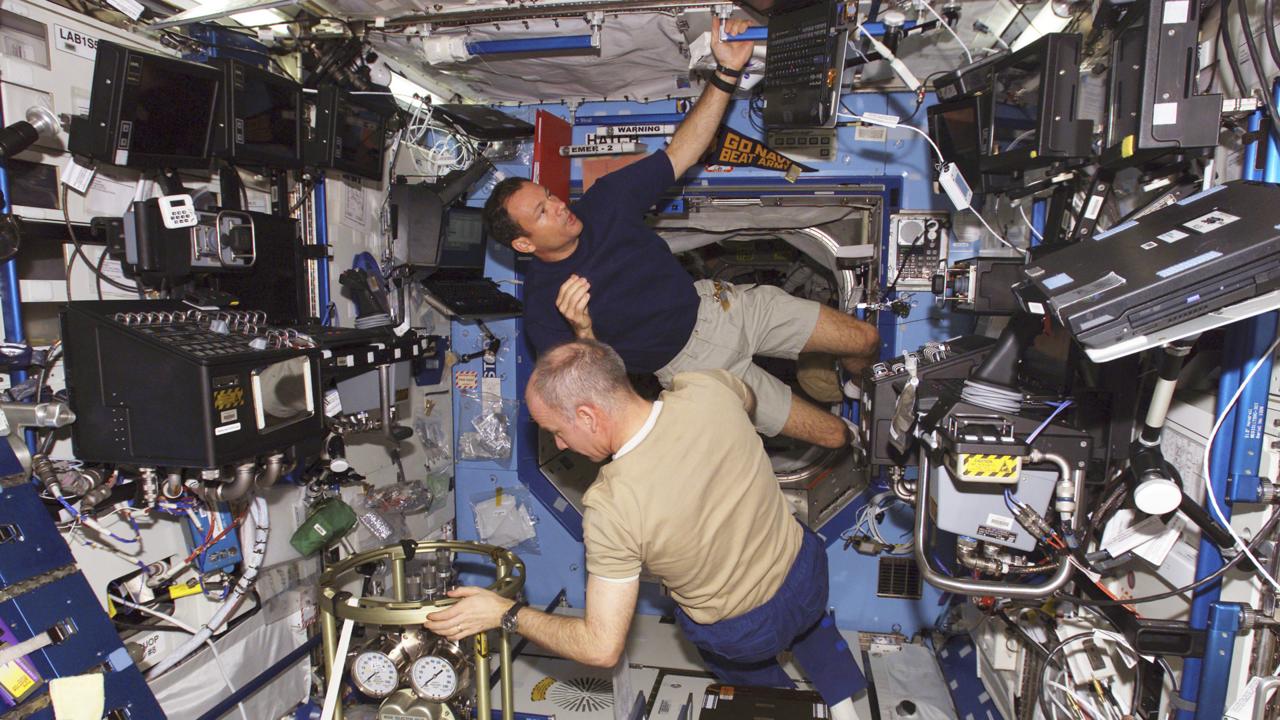
Since its completion in 2011, the $100bn (£64.5bn) ISS has been all about the science. The walls, ceiling and floor of its US, Russian, European and Japanese laboratories are crammed with experiments, and astronauts spend an increasing amount of time as orbiting research technicians.
(Credit: Nasa/Science Photo Library)
The crew are monitored while working to make sure they don't misplace vital equipment (Credit: Nasa/Science Photo Library)

“If you name a discipline of science, we are probably doing that kind of experiment on board,” says Shine. Studies in this unique microgravity research lab range from investigating plant growth to understanding the properties of liquid metals.

Much of the science overseen from the control room in Alabama is concerned with studying the effects of space on the astronauts themselves, such as the bone and muscle wastage they experience. This is essential research if humans are ever to leave their home world for any length of time.
When living in space, is comfort food good for you?
Scientists are also studying the psychological challenges of living away from Earth in an isolated metal box, eating reconstituted meals, drinking recycled urine, with only work colleagues for company.
One of the most intriguing of these experiments – Astro Palate – has been devised by food and nutrition scientists at the University of Minnesota. Among other things, it seeks to understand how food can be used to reduce stress. In other words, when living for a long time in space, is comfort food good for you?

“We may have astronauts do a task they don’t enjoy such as vacuuming the space station,” says Shine. “We then have them take a survey to see how they feel about it, then let them eat some comfort food – perhaps chocolate pudding – and take another survey.”

(Credit: Getty Images)
Comfort food like chocolate pudding can be a powerfully persuasive tool (Credit: Getty Images)

“We’re starting to understand ways of making our crews feel at home as they’re in space for longer and longer durations,” she adds.
Another study involves astronauts keeping journals of their life on board the station – an attempt to get honest accounts of their feelings, stresses, tensions or homesickness. Because only the researcher compiling the results of the project reads them, the hope is that the crew are more likely to be candid.
The fourth month of the mission is when the crew is most likely to want to come home
“One of the most interesting findings is that the fourth month of the mission is when the crew is most likely to want to come home,” says Shine. “They’re getting tired of being on the space station and they want to see their families.”

As most missions to the ISS are now between six months and a year in duration, Nasa may therefore want to consider sending up some more chocolate pudding.

Lost in space
To help cope with the daily frustrations of living on board a cluttered orbiting laboratory, the Alabama team is even responsible for the astronauts’ lost property. It is the job of the Stowage Officer to keep track of every item on the ISS. Shine describes it as “one of the hardest jobs in the space programme”.
Sometimes astronauts don’t put their things away, just like us here on Earth
“Sometimes astronauts don’t put their things away, just like us down here on Earth,” says Shine. “They’ll call down looking for a wrench or something and it’s not where we thought it was, so it’s the job of the stowage officer to go back through the history of where it was last seen and locate it.”

It is the space equivalent of losing your keys and trying to remember where you last had them. The problem is that if you put down your spaceship keys, there is a good chance they will float off somewhere else.

“We’re looking over the astronauts’ shoulders so if we see something float away we’ll let the crew know,” says Shine. “A lot of the time we find things collected in vents.”

It’s always been the case that behind every astronaut there are thousands – if not tens of thousands – of support staff. The difference today, as we enter an era of longer duration missions, is that they are just as likely to be an expert on comfort food or space station storage as a rocket scientist.

14/7/15

Luis Enrique does not want Pedro to leave Barcelona but will respect decision


‘It will be his personal decision,’ says Luis Enrique
• Reported Chelsea target available for £21.4m after buyout clause was reduced
Luis Enrique says he cannot guarantee anyone playing time at Barcelona amid reports Pedro is set to leave.
Luis Enrique says he cannot guarantee anyone playing time at Barcelona amid reports Pedro is set to leave. Photograph: Gustau Nacarino/Reuters
The Barcelona coach, Luis Enrique, says does not want Pedro to leave but will respect whatever decision the Spain forward makes about his future.
Pedro, 27, revealed on Monday that the Spanish and European champions had received offers for him after agreeing to trim the size of his buyout clause and amid reports he is poised to join Chelsea.
A World Cup and European Championship winner with Spain, Pedro lost his place in the Barça starting lineup following the arrival of the Uruguay striker Luis Suárez last year.
Luis Enrique used Pedro mainly as a substitute last term and he came on in the Champions League final to set up Neymar to score the third goal in a 3-1 victory over Juventus.

“I don’t want anyone to leave but there is a clause,” Luis Enrique said. “We have to respect his decision.
“I do not deceive anyone and I do not guarantee anyone playing time. It will be his personal decision.”
Barça begin the defence of their La Liga title at Athletic Bilbao next month, after they meet the Basque club in the Spanish Super Cup and the Europa League champions, Sevilla, in the European Super Cup.

13/7/15

Holidays in Greece: a history in tourism posters

For intrepid early romantics on their Grand Tours to the18 million travellers expected to visit this year, Greece has long been one of Europe’s most alluring destinations. These posters, marking 100 years of what is now the Greek National Tourism Organisation, highlight its winning combination of culture, charm and sunshine

Pluto’s Large Moon Charon Is Stunning

Pluto’s Large Moon Charon Is Stunning

11/7/15

Now that any idiot can send a selfie from Mount Fuji, have we hit peak Wi-Fi?

Due to popular demand, climbers can now shamelessly selfie and check work emails atop Japan’s spectacular peaks. The days of living in the moment are over
With Mount Fuji’s new Wi-Fi, you can show everyone on the internet how cool and adventurous you are next time you’re up there. Photograph: Itsuo Inouye/AP
Wi-Fi is available everywhere these days. You can use Wi-Fi at some New York City subway stations. You can use Wi-Fi at some Subway restaurants. Some people even have Wi-Fi in their homes.
Now, thanks to Japanese government officials, Wi-Fi is also available at the summit of the country’s highest mountain.
From 10 July climbers of the 12,389ft (3,776.24 metres) Mount Fuji will be able to tweet, Instagram and MSN message to their hearts’ content.
That’s great – if you’re an idiot.
Not so long ago the whole point of climbing a big mountain or trekking along a river or crawling into a crevice was the way to escape the travails of normal life. Get away from the noise of horseshoes on cobbles, the allure of the opium den.
Now it is not a legitimate experience unless you document every moment with a selfie or an update that you are “#lovinglife” or having a “cheeky pint”.

Most climbers begin their ascent of Mount Fuji from its “fifth station” (there are 10). The fifth station is at an elevation of 7,562ft (2,305 metres), meaning a climb of a vertical mile, or four Empire State buildings. (You don’t actually climb vertically.) Mountaineers face a risk of altitude sickness and are advised to stop overnight at the seventh or eighth station. For much of the year temperatures are below freezing.
There is no phone signal when you are halfway up the side of a mountain. Japanese officials told the Asahi Shimbun news site that this was a problem, because “many climbers from the United States and Europe have said they wanted to use the internet to share their experiences while on the mountain”. Hence the Wi-Fi.

But why do people want this?
Imagine the sense of elation upon reaching the Mount Fuji summit. Imagine scouring the horizon, knowing you are at the highest point on this fine cluster of islands. Then imagine your phone connecting to the Wi-Fi and receiving an email from your colleague Clive asking if you managed to finish that Woodcock file before you left and, oh, can you gchat Jason? He’s forgotten how to work the fax machine and, hey, what’s the password for that protected Excel spreadsheet again?

That’s the worst-case scenario. But the best-case scenario is still awful.
People will take daft pictures from the top of mountains. Of course they will. That’s the world we live in. But can’t they wait a day, or – God forbid – two days before posting them on MySpace?
Is there no enjoyment in serenity any more? Must we reach Fuji’s crest only to listen to Nora telling her mum over Skype: “Yes the view is amazing. Hey look, I’ll show you – oops sorry, I’ve got my iPad pointing the wrong way, wait a minute there you go. What do you mean you can’t see it? Have you closed the window again? Press escape. Oh well just check my Facebook, there’ll be a picture on there in 15 seconds.”
Now we have Wi-Fi at our most lofty peaks, it is only a matter of time before there is simply no escape from the tyranny of the internet. Fire up your BlackBerry at the Taj Mahal. Tweet that you’re #lovinglife from that desert island you’ve been cast adrift on. Post an Instagram selfie from the grave. #yolo

Wi-Fi atop Mount Fuji is a slippery slope. It’s time to rise up against Wi-Fi atop Mount Fuji. Wi-Fi atop Mount Fuji means Wi-Fi has peaked.

3/7/15

03-07-15 Ανακοίνωση αποτελεσμάτων ειδικών μαθημάτων Πανελλαδικών Εξετάσεων Read more at: http://didefth.gr/new/13461/03-07-15-anakinosi-apotelesmaton-idikon-mathimaton-panelladikon-exetaseon/

Από το Υπουργείο Πολιτισμού, Παιδείας και Θρησκευμάτων ανακοινώνεται ότι οι υποψήφιοι που συμμετείχαν στα ειδικά μαθήματα των Πανελλαδικών Εξετάσεων μπορούν από σήμερα 03/07/2015 μετά τις 11.00 π.μ. να πληροφορούνται τη βαθμολογία τους στην ιστοσελίδα του Υπουργείου results.it.minedu.gov.grπληκτρολογώντας τον οκταψήφιο κωδικό εξετάσεων και τους 4 αρχικούς χαρακτήρες από το επώνυμο, το όνομα, το πατρώνυμο και το μητρώνυμο του υποψηφίου σε κεφαλαίους ελληνικούς χαρακτήρες. Υπενθυμίζεται ότι η προθεσμία οριστικής υποβολής του μηχανογραφικού δελτίου λήγει την Παρασκευή 17/7/2015. Για το δελτίο τύπου πατήστε εδώ.

Read more at: http://didefth.gr/new/13461/03-07-15-anakinosi-apotelesmaton-idikon-mathimaton-panelladikon-exetaseon/
03-07-15 Ανακοίνωση αποτελεσμάτων ειδικών μαθημάτων Πανελλαδικών Εξετάσεων PostDateIcon July 3rd, 2015 Από το Υπουργείο Πολιτισμού, Παιδείας και Θρησκευμάτων ανακοινώνεται ότι οι υποψήφιοι που συμμετείχαν στα ειδικά μαθήματα των Πανελλαδικών Εξετάσεων μπορούν από σήμερα 03/07/2015 μετά τις 11.00 π.μ. να πληροφορούνται τη βαθμολογία τους στην ιστοσελίδα του Υπουργείου results.it.minedu.gov.grπληκτρολογώντας τον οκταψήφιο κωδικό εξετάσεων και τους 4 αρχικούς χαρακτήρες από το επώνυμο, το όνομα, το πατρώνυμο και το μητρώνυμο του υποψηφίου σε κεφαλαίους ελληνικούς χαρακτήρες. Υπενθυμίζεται ότι η προθεσμία οριστικής υποβολής του μηχανογραφικού δελτίου λήγει την Παρασκευή 17/7/2015. Για το δελτίο τύπου πατήστε εδώ.

Read more at: http://didefth.gr/new/13461/03-07-15-anakinosi-apotelesmaton-idikon-mathimaton-panelladikon-exetaseon/
03-07-15 Ανακοίνωση αποτελεσμάτων ειδικών μαθημάτων Πανελλαδικών Εξετάσεων PostDateIcon July 3rd, 2015 Από το Υπουργείο Πολιτισμού, Παιδείας και Θρησκευμάτων ανακοινώνεται ότι οι υποψήφιοι που συμμετείχαν στα ειδικά μαθήματα των Πανελλαδικών Εξετάσεων μπορούν από σήμερα 03/07/2015 μετά τις 11.00 π.μ. να πληροφορούνται τη βαθμολογία τους στην ιστοσελίδα του Υπουργείου results.it.minedu.gov.grπληκτρολογώντας τον οκταψήφιο κωδικό εξετάσεων και τους 4 αρχικούς χαρακτήρες από το επώνυμο, το όνομα, το πατρώνυμο και το μητρώνυμο του υποψηφίου σε κεφαλαίους ελληνικούς χαρακτήρες. Υπενθυμίζεται ότι η προθεσμία οριστικής υποβολής του μηχανογραφικού δελτίου λήγει την Παρασκευή 17/7/2015. Για το δελτίο τύπου πατήστε εδώ.

Read more at: http://didefth.gr/new/13461/03-07-15-anakinosi-apotelesmaton-idikon-mathimaton-panelladikon-exetaseon/